
The Future of Data Space Tooling and AI Synergy
The digital economy is bringing Common European Data Spaces and Artificial Intelligence (AI) into the same operating environment. Training AI systems is a data-intensive, defining a clear need that data can be found, understood and used under clear conditions. This becomes challenging when the data is held by different organisations. Data spaces address this problem without requiring every provider to place its assets in a central platform. They combine exchange mechanisms, identity, policy and governance components, creating a controlled data foundation for AI applications and autonomous agents.
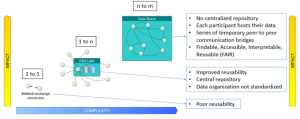
Fig. 1. Data space concept compared with bilateral exchanges and data-lake structures.
Interoperability and the Dataspace Protocol
Within a data space, participants employ connectors to expose data products and services, discovers offers, negotiate agreements and coordinate transfer processes. Rather than creating a single shared repository, connectors allow participants to retain control of their assets, selectively exposing them while interacting through common interfaces [1].
The emerging common language for connectors to browse catalogues and engage in contract negotiations is the Dataspace Protocol (DSP), standardizing the abstraction known as the control plane [2]. The DSP relies on DCAT-based descriptions support publication and discovery, while ODRL policies manages access permissions. The Dataspace Protocol Technology Compatibility Kit tests assesses connector functions, and passing the applicable tests provides evidence of conformance and interoperability with other compliant implementations, in turn granting the foundation for repeatable n-to-m exchange.
Decentralized Claims Protocol
One of the selling points for data spaces is the Trust concept: participants need to be identified, establish who they represent and which qualifications or permissions they hold. The Decentralised Claims Protocol (DCP) addresses this facet, providing an identity-and-trust overlay to DSP [3,4]. DCP uses Decentralised Identifiers and self-issued identity tokens. Participants sign their own tokens, so a single central identity provider does not have to mediate each interaction. Under DCP, Verifiable Credentials (VCs) serve as the primary mechanism for establishing trust and enforcing authorization policies within a dataspace, acting as the digital proof required to access data assets. VCs contain embedded cryptographic proofs that allow their authenticity and integrity to be verified instantly without contacting the original issuer. It is up to the receiving organisation to evaluate whether the presented evidence satisfies its policies.
A Governed Foundation for AI and Agents
The data space connection to AI starts with data products: resources packaged with metadata, access information and usage conditions [5,6]. An AI system needs data, but must also understand what the data represents, where it came from, how current it is and whether it may be used for training, inference or publication. AI agents extend the process from governed access to autonomous action, as an agent operating on its own planning may search catalogues, compare offers, present credentials, negotiate terms and invoke a service. The agent must act for an identifiable organisation, within a defined purpose, authority scope and time limit [7]. Even in this delegated operation, throughout its execution path, the agent´s transactions leave an auditable trace behind, which allows for dispute settling and billing the appropriate party for their services.
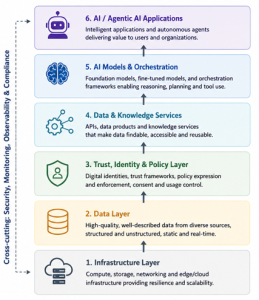
Fig. 2. Layered stack enabling AI and agentic AI applications in data ecosystems.
Outlook
A coordinated technical stack for data exchange (DSP, DCP, DCAT descriptions, ODRL policies) is becoming mature and a solid foundation for data-intensive applications. The remaining task is to fully integrate these components into systems that can be tested and deployed under real operational conditions.
References
[1] Steinbuss, S. and Holesch, M. (2026) Data Space Connector Report. Report No. 2. Dortmund: International Data Spaces Association. doi:10.5281/zenodo.17296513. Online version available at: https://internationaldataspaces.org/idsa-data-space-connector-report/
[2] Eclipse Dataspace Working Group (2025) Dataspace Protocol 2025-1. Available at: https://eclipse-dataspace-protocol-base.github.io/DataspaceProtocol/2025-1/
[3] Eclipse Dataspace Working Group (2025) Eclipse Decentralized Claims Protocol, version 1.0.1. Available at: https://eclipse-dataspace-dcp.github.io/decentralized-claims-protocol/v1.0.1/
[4] Eclipse Foundation (n.d.) ‘Eclipse Dataspace Decentralized Claims Protocol’. Available at: https://projects.eclipse.org/projects/technology.dataspace-dcp
[5] Data Spaces Support Centre (n.d.-a) DSSC Blueprint 3.0: Intro – Key Concepts of Data Spaces. Available at: https://toolbox.dssc.eu/?pane=intro
[6] Data Spaces Support Centre (n.d.-b) DSSC Blueprint 3.0: Technical Building Blocks. Available at: https://toolbox.dssc.eu/?pane=technical
[7] Turkmayali, A., ed. (2026) Data Spaces and AI: Trustworthy Agentic Participation in Data Spaces. Position Paper, version 1.0, July 2026. Dortmund: International Data Spaces Association. doi:10.5281/zenodo.21279055.
[8] Gas, N. (2026) ‘Data Spaces Support Centre launches new phase to drive Common European Data Spaces toward sustainability’, 9 July. Available at: https://dssc.eu/articles/dssc-launches-new-phase-2026