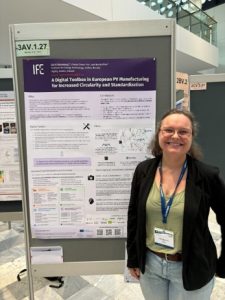
The 43rd European Photovoltaic Solar Energy Conference and Exhibition, or EU PVSEC, was held in Rotterdam, Netherlands from 14th to 18th of September, 2026. CIRCMAN5.0 was represented by IFE, who also presented a poster in the very first poster session on Monday morning.
The EU PVSEC is the largest international conference for research on photovoltaics, including both science-to-science and science-to-industry focuses. The conference included 5 topics, which were
- Silicon Materials and Cells
- Perovskites and other Thin-films; Tandems; New Concepts
- Photovoltaic Modules
- Systems Design and Operation: Applications
- Photovoltaics in the Energy Transition
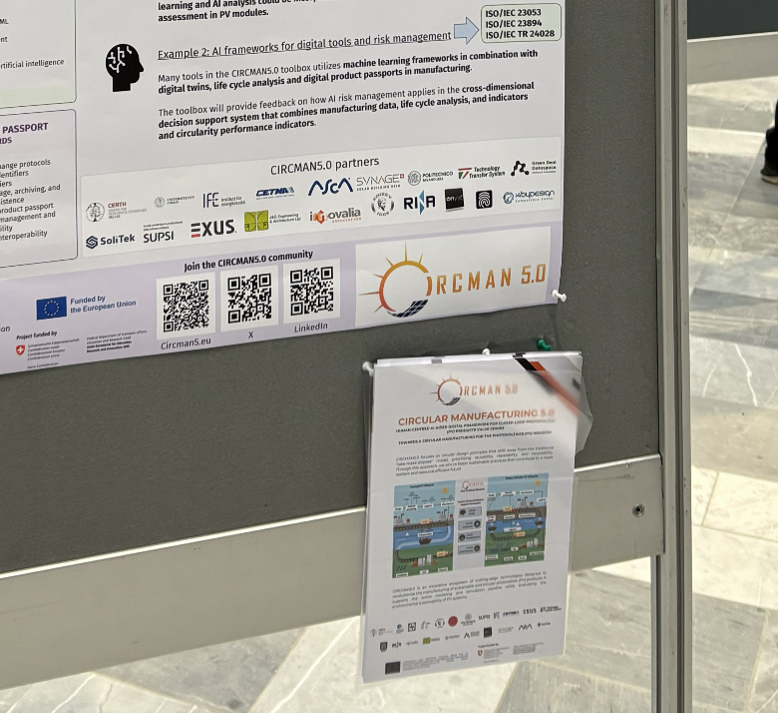
The CIRCMAN5.0 poster was presented within topic 3.1 PV Module Design and Manufacturing, and was available for all participants at the conference throughout the week, with both calling cards and flyers available for those interested. The poster was focused on the impact the CIRCMAN5.0 digital toolbox can have on a scope of international standards, highlighting the AI defect detection tool for electroluminescence inspection of PV modules during manufacturing, as well as the AI frameworks for digital tools and risk management. The poster had code 3AV.1.27, and will be available through the conference poster proceedings.
The EU PVSEC consists of 6 auditoriums with 5 sessions each day as well as poster sessions, giving more than 30 individual sessions for participants to join and interact with their interests within PV. For CIRCMAN5.0, the most interesting sessions were within sustainability and module manufacturing, in topics 3 and 5. Sessions to be highlighted was the plenary session “Silicon PV Design, Manufacturing and Circularity” that took place Wednesday morning, and the sessions Wednesday afternoon on Recycling & Reuse of PV Modules and Challenges for Manufacturing in Europe.
One key take-away for me was a quote from Prof. Dr. Dirk-Holger Neuhaus from Fraunhofer-Institut für Solare Energiesysteme ISE, who presented the talk “Module Technology Innovations – Performance, Cost and New Market Applications” on Wednesday before lunch. He presented the potential of integrated photovoltaics, which he stated is especially high for building-integrated PV, such as manufactured by the pilot partners in CIRCMAN5.0. On European rooftops alone, the potential capacity could reach 2.3 TWp with an annual output of 2,750 TWh based on current PV technology (G. Kakoulaki et al, 2026, Nature Energy). There are many challenges before this amount of integrated PV can be realized, such as complex design and high product variety, module costs, and manual processes. Prof. Neuhaus further detailed the main approaches for improvement as 1) digital design and digitally-supported certification, 2) highly automated, flexible manufacturing, and 3) digital planning processes.
Luckily, CIRCMAN5.0 can provide digital tools to cover all three approaches for improvement. This provision highlights the importance of the CIRCMAN5.0 digital toolbox in a competitive manufacturing landscape for PV in Europe, and gives motivation for us to keep working on developing the tools, validating them in the pilots, and then making them available for other organizations and projects through exploitation in the final months of the project.